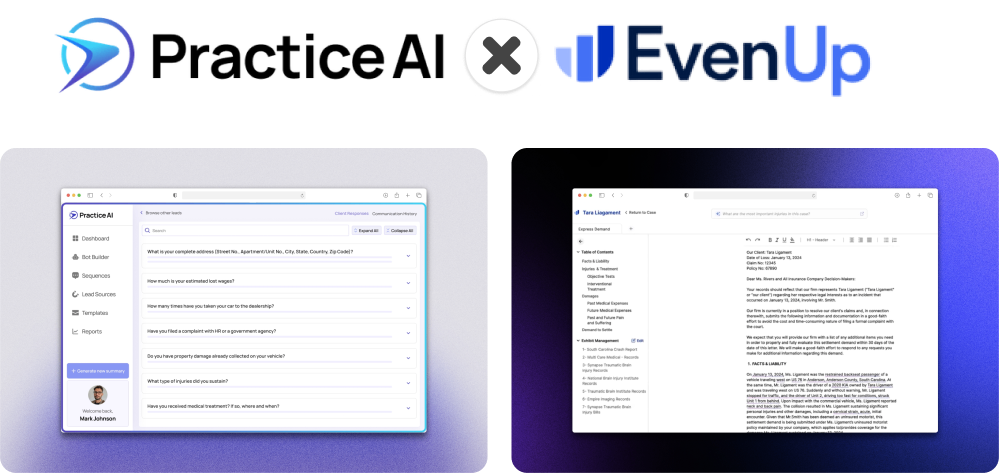
Practice AI™ vs. EvenUp™: Which Legal AI Tool Best Serves Your Firm's Needs?
To provide a clear, unbiased comparison between Practice AI™ and EvenUp™, highlighting their features, benefits, and limitations. This will assist legal professionals in making informed decisions about which AI tool aligns best with their firm's requirements.
In today's fast-paced legal environment, efficiency and accuracy are paramount. Legal professionals are increasingly turning to AI-powered legal tools to streamline tasks like drafting personal injury demand letters, summarizing medical records, and managing case workflows.
Two prominent players in this space are Practice AI™ and EvenUp™. While both offer solutions aimed at enhancing legal operations, they differ in features, performance, and user experience. This article delves into a side-by-side comparison to help you determine which tool aligns best with your firm's needs, especially if you're searching for the best AI for lawyers or evaluating AI legal assistant platforms.
What Practice AI™ Offers
Practice AI™ is designed to automate and simplify the drafting process for legal professionals. Key features include:
AI-Generated Demand Letters: Quickly create precise and persuasive AI-powered demand letters tailored to various case types, including personal injury and lemon law. This is ideal for attorneys looking for an AI legal document generator that saves time and boosts accuracy.
Medical Records Summaries and Chronologies: Automatically generate comprehensive summaries and timelines from medical records, aiding in case preparation and strategy. This capability is especially beneficial for firms handling AI for healthcare legal cases or needing AI document summarization for large files.
HIPAA-Compliant Storage via Microsoft Azure: Ensures that all data is stored securely, maintaining compliance with healthcare privacy regulations. This meets the growing need for AI HIPAA compliance and addresses concerns around data security in AI.
Customizable Templates and User Access Controls: Offers flexibility in document formatting and robust access management to maintain data integrity and security—ideal for firms seeking legal document automation tools or investing in AI for legal professionals.
What EvenUp™ Offers
EvenUp™ provides AI-driven solutions aimed at personal injury law firms. Its offerings include:
AI-Generated Demand Letters with Human Review: Combines AI demand letter drafting with in-house legal expert reviews to produce demand letters.
Medical Chronologies and Case Preparation Tools: Assists in organizing and summarizing medical information pertinent to cases, helping attorneys manage workflows that intersect with AI in medical tech or AI for medical records.
Integration of Proprietary AI Models and In-House Legal Expertise: Utilizes a combination of AI technology and legal professionals to enhance document quality.
Key Differences at a Glance
Feature
Practice AI™
EvenUp™
AI-Generated Demand Letters
✅ Yes
✅ Yes, with human review
Medical Records Summaries
✅ Yes
✅ Yes
HIPAA-Compliant Storage
✅ Yes (Microsoft Azure)
🟧 Partial (SOC 2, not HIPAA-certified)
Customizable Templates
✅ Yes
❌ No
User Access Controls
✅ Yes
❌ No
Delivery Time
✅ Fast and predictable
❌ Slow and unpredictable
Legal Citations in Documents
✅ Comprehensive
❌ Limited
Revision Flexibility
✅ Unlimited
❌ Limited
Billing and Sign-Up Process
✅ Transparent and straightforward
❌ Confusing and costly
Document Output Formats
✅ Multiple formats
❌ Word files only
Which Tool is Best for Your Firm?
Practice AI™ is ideal for firms seeking:
Efficiency: Rapid generation of demand letters and medical summaries in minutes.This is especially useful for law offices handling bulk documentation, including AI-generated legal documents for high-volume caseloads.
Customization: Flexibility in document templates and formatting makes Practice AI™ an ideal solution for those exploring AI for attorneys
Security: Robust data protection with HIPAA-compliant storage and user access controls—important for firms handling sensitive client records and those interested in AI in data security or AI for medical professionals.
EvenUp™ may suit firms that:
Prefer Human Oversight: Value the combination of AI drafting with human legal review, especially in complex personal injury or lemon law cases where nuance is critical.
Focus on Personal Injury Cases: Specialize in personal injury law and can accommodate the platform's limitations.
Why Practice AI™ Is the Best AI Legal Assistant for Law Firms
Selecting the right AI tool is crucial for enhancing your firm's productivity and client service. Practice AI™ offers a comprehensive, secure, and customizable solution that addresses common pain points in legal document preparation. Its emphasis on speed, accuracy, and user control makes it a compelling choice for modern legal practices evaluating AI in the legal field or looking to invest in AI for law firms.
The platform is led by industry veteran Hamid Kohan, whose vision for legal AI innovation continues to shape how law firms adopt intelligent automation tools.He has proven that in this lifetime, AI is indeed a useful tool to support human efforts and he showed it through the platform, Practice AI.
Explore Practice AI™ today to experience how it can transform your legal operations, whether you’re looking to automate legal documents, improve AI-powered legal writing, or drive faster resolutions with AI for faster settlements. Schedule a demo or start your free trial to see the benefits firsthand.
The legal industry is experiencing a fundamental shift. In 2025, artificial intelligence is no longer experimental or optional for law firms. AI tools for law firms have become core infrastructure, reshaping how legal professionals manage cases, communicate with clients, and deliver results faster than ever before.
Lawyers today face mounting pressure. Clients demand speed, transparency, and cost efficiency. Competition is increasing. Case volumes are growing. Traditional workflows—manual document review, repetitive drafting, and fragmented tools—are no longer sustainable. This is where legal AI steps in.
AI in law is not about replacing attorneys. It is about amplifying legal expertise. Modern law practice AI software helps lawyers reduce administrative work, improve accuracy, and focus on strategy, negotiation, and advocacy. From AI demand letters to automated client intake and litigation support, AI legal tools are redefining legal work across the entire firm.
In this article, we explore how AI tools for law firms are changing legal practice in 2025, the key areas being transformed, and why firms that adopt AI early gain a lasting competitive advantage.
1. The Rise of AI in Law Practice
AI adoption in legal practice has accelerated rapidly over the past few years. In 2025, the use of AI in law practice is driven by necessity, not novelty. Law firms are dealing with more data, more documents, and tighter timelines. Human-only workflows simply cannot scale at the same pace.
Legal AI tools now assist with tasks that once required hours of manual effort. These include reviewing medical records, summarizing cases, drafting demand letters, organizing evidence, and preparing litigation materials. AI systems analyze large volumes of legal data in minutes, identifying patterns and extracting key facts with high accuracy. One major factor behind this rise is improved AI reliability. Earlier concerns about accuracy and hallucinations are now addressed through structured workflows, source citations, and human review layers. Modern law practice AI software is designed specifically for legal use cases, not generic writing.
Another driver is cost pressure. Clients increasingly resist high fees for routine work. AI allows firms to reduce operational costs while maintaining quality. This enables predictable pricing models and better client satisfaction.
AI in legal practice is no longer limited to large firms. Solo practitioners and mid-sized firms now use AI-powered practice management tools to compete at a higher level. In 2025, the question is not whether AI will be used in law—but which firms will use it best.
2. AI Tools for Law Firms and Workflow Automation
One of the biggest impacts of AI tools for law firms is workflow automation. Legal work involves countless repetitive steps that consume time without adding strategic value. AI automates these steps while keeping lawyers in control.
Client intake is a strong example. AI-powered intake systems can engage leads automatically, collect structured information, and qualify cases before a lawyer ever reviews them. This reduces back-and-forth communication and ensures no opportunity is missed.
Document collection is another area transformed by AI. Instead of manual follow-ups, AI systems send reminders, track uploads, and organize documents by case. This eliminates chaos and ensures every file is accessible when needed. Case organization has also improved. AI legal tools group documents by provider, date, or issue, creating a single source of truth. Lawyers no longer waste time searching across folders, emails, or systems.
Workflow automation does not remove judgment. It removes friction. Lawyers still make decisions, approve outputs, and define strategy. AI simply ensures that routine tasks happen faster, cleaner, and with fewer errors.
In 2025, firms using AI-powered workflow automation close cases faster, respond to clients quicker, and operate with smaller teams—without sacrificing quality.
3. AI Demand Letters and Faster Case Resolution
AI demand letters are one of the most practical applications of legal AI in 2025. Drafting demand letters traditionally required hours of writing, reviewing records, calculating damages, and formatting exhibits. AI has streamlined this entire process. Modern AI demand letter tools generate structured, evidence-backed drafts using uploaded medical records, bills, and case facts. The system organizes treatment summaries, calculates specials, and references exhibits automatically. Lawyers then review, edit, and finalize the output.
This process offers multiple advantages. First, it dramatically reduces drafting time. What once took days can now be completed in minutes. Second, it improves consistency. AI ensures every demand follows firm standards and includes required sections.
AI also supports multiple demand types, such as standard demands, policy-limit demands, and settlement offers. Each output is tailored to the case context. This flexibility allows lawyers to respond strategically without rewriting from scratch.
Faster demand generation leads to faster settlements. Insurers receive clear, well-supported letters sooner, reducing delays and disputes. In 2025, firms using AI demand letters resolve cases more efficiently and improve cash flow.
4. Case Summaries Powered by AI Legal Tools
Case summaries are critical in legal practice. They inform strategy, negotiation, and litigation decisions. In the past, summarizing records required manual review of hundreds or thousands of pages. AI has transformed this process.
AI-powered case summary tools analyze uploaded documents and produce structured summaries that highlight key facts, timelines, providers, and treatments. Chronologies are generated automatically, allowing lawyers to spot gaps or inconsistencies quickly.
These AI legal tools do not replace legal judgment. They accelerate preparation. Lawyers spend less time reading raw records and more time analyzing implications.
Case summaries are especially valuable for team collaboration. Paralegals can prepare summaries quickly. Attorneys can review outputs and focus on higher-level strategy. New team members can onboard to cases faster. In litigation, AI-generated summaries support discovery, depositions, and trial prep. Lawyers enter proceedings with a clearer understanding of the case narrative. In 2025, AI case summaries are becoming a standard expectation, not a luxury.
5. AI for Legal Research and Litigation Support
AI in legal practice extends beyond drafting and organization. Legal research and litigation support are also being transformed.
AI legal tools can analyze prior cases, identify relevant precedents, and summarize legal arguments faster than traditional research methods. This reduces research time while expanding coverage. In litigation support, AI assists with discovery review, issue spotting, and trial preparation. It helps lawyers organize exhibits, prepare witness outlines, and test arguments against case facts. These tools are especially valuable in complex cases with large document volumes. AI accelerates preparation without compromising accuracy, provided human verification remains in place.
In 2025, AI is becoming an essential research partner. Lawyers who combine legal expertise with AI insights gain stronger arguments and improved confidence in court.
6. AI-Powered Practice Management and Firm Operations
Beyond legal work itself, AI is reshaping firm operations. AI-powered practice management tools help law firms run more efficiently. These systems track workloads, identify bottlenecks, and optimize resource allocation. AI insights reveal where time is lost and where processes can improve. Billing and reporting also benefit from AI. Automated tracking reduces leakage and improves transparency. Firms can analyze performance metrics and make data-driven decisions. AI-powered practice management enables scalability. Firms can grow without proportionally increasing staff. This is critical in a competitive market.
In 2025, operational excellence is a differentiator. Firms using AI to manage their practice operate leaner, smarter, and more profitably.
7. Ethics, Accuracy, and Challenges of AI in Legal Practice
Despite its benefits, AI in legal practice presents challenges. Accuracy, ethics, and compliance remain top concerns.
AI systems must never invent facts. Lawyers are responsible for verifying outputs against source documents. Responsible AI tools include guardrails, citations, and regeneration workflows to support verification. Confidentiality is another concern. Legal AI platforms must meet strict security standards, including SOC 2 and HIPAA compliance where applicable. There are also ethical considerations. Lawyers must understand how AI tools work and disclose AI use when required. AI should support professional judgment, not replace it.
In 2025, firms that succeed with AI are those that combine technology with strong governance, training, and review processes.
8. Why AI Tools for Law Firms Are a Competitive Advantage
AI tools for law firms are no longer optional. They are a competitive advantage.
Firms using AI handle more cases with fewer resources. They respond faster, reduce errors, and deliver consistent quality. Clients notice the difference.
AI also improves job satisfaction. Lawyers spend less time on repetitive tasks and more time on meaningful legal work. This reduces burnout and improves retention.
In a crowded market, firms that adopt law practice AI software position themselves as modern, efficient, and client-focused.
Final Thoughts: The Future of Legal Work
In 2025, AI is redefining how legal work is done. From intake to settlement, AI tools for law firms streamline processes, enhance accuracy, and unlock new levels of efficiency. Law Practice AI and similar platforms are not replacing lawyers. They are empowering them. The future belongs to firms that embrace AI thoughtfully, ethically, and strategically. Those firms will not only survive—but lead.
Working in personal injury law can be fulfilling, but it often involves a huge amount of paperwork. The workload from managing complex cases and writing detailed demand letters can be overwhelming, leading to stress and eventually burnout, which affects not just you but your clients and team as well.
Our Demands AI solution offers a smarter approach. It automates tedious tasks, helping you stay focused, reduce stress, and provide top-notch representation for your clients. But how exactly does Demands AI help prevent burnout in your practice?
Table of Contents:
The Hidden Costs of Burnout in Personal Injury Law
How Demands AI Eases the Burden
Types of Demand Letters Generated
Types of Documents Generated
Experience the Difference: Try AI Demand
The Hidden Costs of Burnout in Personal Injury Law
Burnout doesn't just mean being tired. It’s a state of emotional, physical, and mental exhaustion caused by ongoing stress, and it's common in personal injury law. When burnout hits, several areas suffer:
Longer Hours, Less Productivity: Spending hours drafting letters manually extends your workday and sacrifices family time, leading to exhaustion.
Mistakes and Missed Details: Overwork increases the risk of overlooking important details or making errors, which can compromise a case.
Strained Client Relationships: When you're overloaded, clients may feel neglected, eroding trust and damaging your relationship.
Team Morale: Burnout impacts not just you, but your team too. Paralegals and junior attorneys with repetitive tasks see their motivation dip, affecting overall productivity.
The solution? Burnout is avoidable. Automating routine work helps you work smarter, not harder. That’s the strength of AI Demand. Click here to sign up for a trial.
How Demands AI Eases the Burden
Stop Wasting Time on Repetitive Drafting: Writing demand letters from scratch takes time. Demands AI produces detailed, professional letters swiftly, freeing you to engage in other important tasks.
Keep It Compliant, Without the Stress: Ensuring compliance with legal standards is vital. Demands AI updates with the latest requirements, ensuring your letters meet all legal criteria without stress.
Consistency You Can Rely On: With multiple cases, quality may fluctuate. Demands AI provides consistent, high-quality documents every time, similar to having a reliable assistant.
Free Up Your Team to Focus on What Matters: Burnout affects your team. By handling repetitive tasks like drafting letters, Demands AI allows your team to concentrate on engaging work, boosting morale.
Focus on What You Do Best: Every minute on routine drafting is time not spent on crucial tasks like negotiations or client relations. Demands AI lets you focus on these high-value tasks.
Types of Demand Letters Generated
Demands AI simplifies demand letter creation for personal injury cases using pre-built templates compliant with legal statutes. Types include:
Motor Vehicle Accidents:
Global Policy: Covers cases with multiple insurance policies, ensuring all applicable coverage is considered.
Regular Time Limit: Ensures timely submission within legal time constraints for standard motor vehicle claims.
Third Policy: Involves cases where additional policies, such as those of a third party, need to be included in the demand letter to secure full compensation.
Dog Bites: Crafts compassionate letters addressing the injury seriousness and relevant laws.
Premise Liability (Slip and Fall) Cases: Drafts letters outlining accident details and property owner negligence, including evidence like medical reports and witnesses.
Medical Summaries: Converts complex medical records into concise summaries, focusing on key details for negotiations or court.
Case Summaries: Summarizes key facts and legal arguments, keeping you organized and clients informed.
Medical Chronologies: Details medical events' timelines, illustrating injury progression and impact.
Custom Demand Letters: Tailored to unique case details, allowing incorporation of client-specific information.
Automating these documents using Demands AI ensures error reduction and enhances your case materials' quality.. Click here to sign up for a trial
Experience the Difference: Try Demands AI
The best way to understand how Demands AI can revolutionize your practice is to try it firsthand. We're offering a free trial, so you can see just how much time and stress you can save by letting AI handle the paperwork.
Why wait? Sign up for the free trial today and discover how Demands AI can help you work smarter, avoid burnout, and give your clients the exceptional representation they deserve.
Ready to take the first step toward a better work-life balance?
Sign up for your trial of Demands AI now and see how it can change the way you work.
The lemon law field is booming in states with strong consumer protections, high car ownership, and dense legal markets. California, Texas, and Florida lead the pack—offering both high demand and intense competition.
If you run a lemon law firm in one of these states, you already know the grind: pulling repair histories, drafting demand letters, managing intake, and chasing signatures. Now multiply that by 30 cases. It’s exhausting.
Learn how top firms are staying ahead—not by hiring more staff, but by using AI-powered legal tools to scale smarter.
1. Lemon Law in California
Why California Leads in Lemon Law Cases
Recent data shows that California saw over 20,000 lemon law lawsuits filed in a single year, with major automakers like General Motors and FCA frequently named defendants. Thanks to the Song-Beverly Consumer Warranty Act, car buyers have some of the strongest protections in the country. With over 14 million registered vehicles, California remains the nation’s top state for lemon law litigation.
The firms we work with in California tell us the same thing: it’s not about finding cases anymore, it’s about handling them efficiently. That’s where AI steps in—not to replace attorneys, but to handle the repetitive work that eats up hours. The firms that grow fastest here are the ones that lean into smart systems, not just more staff.
How California Law Firms Are Using AI
Many California law firms are modernizing with AI-powered tools to manage the high volume of lemon law cases. Firms use AI to:
Draft and customize demand letters in minutes.
Automatically scan vehicle service records for qualifying defects.
Predict case outcomes based on settlement data.
The State Bar of California has even addressed AI integration in legal work, emphasizing the importance of ethical oversight and informed usage.
2. Lemon Law in Texas
Why Texas Has a Booming Lemon Law Practice
Texas has one of the busiest lemon law programs in the country, overseen by the Texas Department of Motor Vehicles (TxDMV). Consumers can file complaints without hiring an attorney, but many turn to specialized lemon law lawyers to navigate complex vehicle disputes—especially in used car or RV cases.
Texas's vast geography and major metro areas like Houston, Dallas, and Austin create a dense legal market for auto-related claims.
How Texas Law Firms are Adopting AI
Texas firms are using AI in practical, results-driven ways. Many have implemented AI chatbots to streamline client intake and improve response times. Others rely on automated legal assistants to help with case triage and prioritize incoming matters. Document generation tools are also becoming essential, assisting with the quick creation of case summaries, filings, and other routine paperwork.
The State Bar of Texas has acknowledged AI’s growing role, with guidance around ethical use, emphasizing that AI tools must serve—not replace—the lawyer.
3. Lemon Law in Florida
Why Florida Is a Rising Lemon Law Hub
Florida’s Motor Vehicle Warranty Enforcement Act (commonly known as Florida’s Lemon Law) protects consumers who purchase or lease defective vehicles. With more than 1,000 lemon law cases annually, and a strong pipeline of leased vehicles, the demand for legal help continues to grow—especially in cities like Miami, Tampa, and Orlando.
Florida's lemon law also requires arbitration before litigation, which encourages many law firms to streamline their processes and offer competitive flat-fee structures.
How Florida Firms Are Leveraging AI
Florida firms are embracing AI to increase profitability while handling time-consuming documentation:
Generative AI is being used to create draft legal documents and summarize case notes.
Predictive AI helps firms evaluate the likelihood of success before filing suit.
Tools like AI Demands™ or custom-built chatbots enhance productivity without sacrificing compliance.
The Florida Bar recently released an advisory confirming that lawyers may use AI tools—provided they supervise the output and maintain ethical standards.
Why Do Law Firms Need AI for Lemon Law Cases?
With increasing competition in California, Texas, and Florida, firms that handle lemon law cases are turning to automation and AI to maintain their edge:
Time Savings – Automate routine filings and follow-ups.
Scalability – Handle 3x the caseload without 3x the headcount.
Whether you're among the lemon law attorneys in California or a growing firm in Florida or Texas, automation is becoming the key to scaling smartly.
Advantages of Using AI in Lemon Law Practices
Law firms handling lemon law cases in high-demand states like California, Texas, and Florida are increasingly turning to AI in law practice to gain a competitive edge. By adopting AI for law firms and leveraging tools designed for AI lawyers, these artificial intelligence law firms are streamlining their processes, enhancing productivity, and improving client outcomes.
Faster Case Screening using pattern-recognition tools
Improved Document Accuracy with legal-specific AI proofreading
Built-in Compliance with your state’s legal standards
Future-Proof Your Lemon Law Firm with AI!
As case volumes increase and clients expect faster resolutions, AI isn’t a luxury—it’s a necessity. The legal industry is changing, and early adopters in high-demand states like California, Texas, and Florida are already seeing the payoff. Whether you're managing lemon law demand letters or scaling intake for high volumes of claims, AI-powered legal tools like AI Demands™ for lemon law cases are helping firms boost efficiency without hiring more staff.
Lemon law attorneys in California, Texas, and Florida—some of the busiest jurisdictions in the country—are already adopting automation to stay ahead. If you’re a lawyer for lemon law searching for ways to meet rising demand or stand out among the best lemon law lawyers near me, now is the time to act.
Your clients are looking for fast answers. Make sure your firm delivers.
Discover how your firm can thrive with AI at Law Practice AI now!